|
Berman Music Foundation 1995-2013
Tony Rager
Grace Sankey-Berman
Wade Wright
Dan DeMuth
Russ Dantzler
Gerald & Leslie Spaits
Tom Ineck
Kay Davis Memorial
BMF donates collection to UNL
UNL News Release
Omaha World-Herald Editorial
|
April 2013
Feature Articles
Music news, memorials, commentary |
|
Feature Story
Berman Music
Foundation gave joy to many
By Tom Ineck
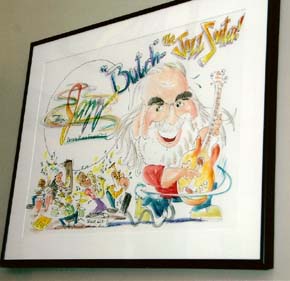
LINCOLN, Neb.—From its inception in the
spring of 1995, the Berman Music Foundation has been dedicated to
bringing the joy of high-quality American music to a broader audience, in Butch
Berman’s hometown and far beyond.
 The
foundation’s stated mission is to “protect and promote” this music through
education, philanthropy and performance. In the course of its 18-year history,
the BMF has bestowed dozens of grants supporting hundreds of musicians. I will
not detail them all here. Suffice it to say that you can peruse the complete
list of sponsorships in reverse chronological order on the
Mission page of this website. The
foundation’s stated mission is to “protect and promote” this music through
education, philanthropy and performance. In the course of its 18-year history,
the BMF has bestowed dozens of grants supporting hundreds of musicians. I will
not detail them all here. Suffice it to say that you can peruse the complete
list of sponsorships in reverse chronological order on the
Mission page of this website.
The first beneficiaries of BMF largesse were
singer Karrin Allyson and her band—and the audience at the Zoo Bar, Lincoln’s
premier music club to this day and one of Butch’s favorite venues. It was March
1995 and Karrin was accompanied on stage by her
Kansas City-based colleagues, pianist Paul Smith, guitarist Danny Embrey,
bassist Bob Bowman and drummer Todd Strait.
The BMF was off and running, with three more
major events in that first year. In August,
Claude "Fiddler" Williams performed at the Zoo
Bar with the New York All-Stars, featuring singer Kendra Shank, pianist Jaki
Byard, bassist Earl May and drummer Jackie Williams. In October at the same
venue, it was the Quintet of the Hot Club of San Francisco with singer Barbara
Dane. Karrin returned to Lincoln in December for performances on two consecutive
nights at Huey's Fine Food & Spirits, this time with Paul Smith, Bob Bowman,
Todd Strait, guitarist Rod Fleeman, saxophonist Kim Park, and trumpeter Stan
Kessler.
 Among other local venues favored by Butch and the foundation
through the years were the Lied Center for Performing Arts, the Cornhusker
Hotel, the Embassy Suites, Westbrook Recital Hall, the outdoor Jazz in June
concert series, the Royal Grove, the Downtown Senior Center and the now-defunct
P.O. Pears, Café de Mai, Huey’s, Ebenezer’s and Prime Time. The BMF also funded
and traveled to festivals in Kansas City, Mo., and Topeka, Kan., and sponsored
occasional performances at the Brownville Concert Hall in Brownville, Neb. Among other local venues favored by Butch and the foundation
through the years were the Lied Center for Performing Arts, the Cornhusker
Hotel, the Embassy Suites, Westbrook Recital Hall, the outdoor Jazz in June
concert series, the Royal Grove, the Downtown Senior Center and the now-defunct
P.O. Pears, Café de Mai, Huey’s, Ebenezer’s and Prime Time. The BMF also funded
and traveled to festivals in Kansas City, Mo., and Topeka, Kan., and sponsored
occasional performances at the Brownville Concert Hall in Brownville, Neb.
But the history of the Berman Music Foundation is largely the
history of Butch Berman and the many friends he gathered around him as
colleagues and worthy recipients of BMF grants. It
is the story of musicians Norman Hedman, Ahmad Alaadeen, Russ Long, Bobby
Watson, Rob Scheps, George Cables, Jane Jarvis, Greg Abate, Claudio Roditi,
Eldar Djangirov, Giacomo Gates, Joe Cartwright, and others who made repeat
appearances with BMF funding. A list of these artists and others, with links to
stories we wrote about them, can be found on the Artists
page of this website.
The BMF story is also about the many who worked
for the foundation over the years. To Butch, they were always friends first,
then colleagues whose work was vital to
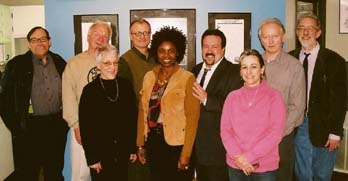
the foundation’s success. Chief among them were the hand-picked consultants
(Wade Wright, Dan DeMuth, Kay Davis, Russ Dantzler, Grace Sankey-Berman, Tony
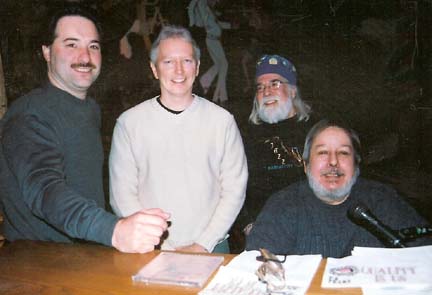
Rager, Gerald and Leslie Spaits and I, pictured below before the grand opening
of the Burkholder Project offices in 2009). They also included Rich
Hoover, photographer, videographer, writer,
driver
 and
Butch’s weekly dining companion at area
eateries, usually in search of the best finger-lickin’ fried
chicken. Susan Berlowitz was the first BMF
newsletter editor, a position later filled by the multi-talented Dave Hughes,
who also booked rooms for musicians, helped to get contracts mailed and signed
and generally kept the BMF office running until his departure in 2002. That same
year, Glennda Magner designed the rough prototype of the current BMF website.
Rebecca Kaiser redesigned the BMF newsletter in 2000, a design that was largely
continued until the final online newsletter was posted in October 2010. All
newsletters from 1995 through 2010 are available in PDF format on the
Newsletter page of this website. and
Butch’s weekly dining companion at area
eateries, usually in search of the best finger-lickin’ fried
chicken. Susan Berlowitz was the first BMF
newsletter editor, a position later filled by the multi-talented Dave Hughes,
who also booked rooms for musicians, helped to get contracts mailed and signed
and generally kept the BMF office running until his departure in 2002. That same
year, Glennda Magner designed the rough prototype of the current BMF website.
Rebecca Kaiser redesigned the BMF newsletter in 2000, a design that was largely
continued until the final online newsletter was posted in October 2010. All
newsletters from 1995 through 2010 are available in PDF format on the
Newsletter page of this website.
Tony Rager, Dan Stogsdill, and Kay Davis of the Cline Williams law firm ensured that many of
Butch's music dreams were realized without bankrupting the foundation. When
Butch's appetites for music, music equipment and other entertainment got out of
hand, they wisely put him on an allowance. But the relationship was always one
of mutual respect.
 Ruthann
Nahorny was Butch’s valued assistant for years. Among other things, she kept his
vast music collection in alphabetical order.
Terry Schwimmer
acted as all-around handyman, and Paul Kelly created a digital catalog of
the entire
BMF
collection. Others too numerous to mention furthered the foundation’s mission
through the years. Ruthann
Nahorny was Butch’s valued assistant for years. Among other things, she kept his
vast music collection in alphabetical order.
Terry Schwimmer
acted as all-around handyman, and Paul Kelly created a digital catalog of
the entire
BMF
collection. Others too numerous to mention furthered the foundation’s mission
through the years.
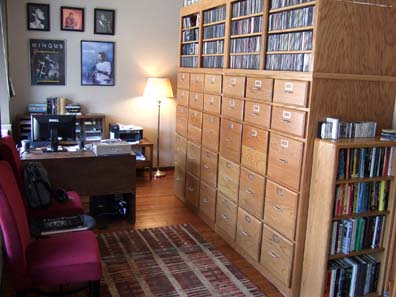
The Berman Music Foundation recently vacated its
offices at The Burkholder Project, where they were housed since 1995, first in
the lower level and—since late 2008—in a large apartment on the second floor
that afforded enough space for the entire collection after it was removed from
Butch’s house. We will miss having a “brick and mortar” presence, but the
collection’s new home at the UNL School of Music library will continue the BMF
tradition of sharing the joy of music. The official UNL news release on the
donation and a nice
Omaha World-Herald editorial on the gift are posted below.
Unfortunately, the hometown Lincoln Journal Star chose not to cover the story.
This website will continue as an archive of the
foundation’s first 18 years. The Feature Articles
pages contain music news, artist interviews, commentary, memorials and other
stories. The Performances pages feature reviews
of concerts, festivals and small club shows. Butch Berman, Rich Hoover, Bill
Wimmer, and I wrote hundreds of jazz and blues CD reviews, which can be found on
the CD Reviews pages. In addition, I wrote
reviews of 26 classic recordings which are posted on the
Essential CDs pages. Of course, Butch’s
one-of-a-kind musings on many subjects can be found on the Prez Sez
pages. His last was posted in January 2008, the month he died. Butch's
44-year professional music career is detailed on the Rock
'n' Roll page, complete with vintage photos and comments by Butch.
BMF trustee Tony Rager, Butch's widow and soul mate Grace Sankey-Berman and the
rest of the BMF consultants offer their personal tributes below. We
also offer a memorial to Kay Davis, who died in February. May
the music never end.
top |
|
BMF Tribute
18 years on, Berman foundation turns a page |
|
By Tony Rager
Trustee, Berman Music Foundation
LINCOLN, Neb.—Eighteen years ago, I sat
in a conference room and watched Butch Berman sign the documents that
created the Berman Music Foundation. There have been 18 years of
wonderful memories and amazing music. We’ve worked with incredible
musicians and devoted fans of all forms of music.
 The Berman Music Foundation is not
going away. We are turning the page on a new chapter. Butch passed away
five years ago and, as I wrote then, his vision and his spirit will
continue. His legacy will have many chapters. The Berman Music Foundation is not
going away. We are turning the page on a new chapter. Butch passed away
five years ago and, as I wrote then, his vision and his spirit will
continue. His legacy will have many chapters.
Due to financial constraints, the BMF
will refocus the direction of its mission. As many of you know, the
foundation recently donated its extensive music collection, photographs,
posters and literature to the University of Nebraska-Lincoln School of
Music library. This donation will continue the mission of the foundation
to promote and protect unique forms of music.
Butch always wanted music to be heard
and felt. Now, new generations of artists, scholars and fans will
have the opportunity to enjoy the collection. Music that truly is unique
and deserves preservation is available to thousands of people for study
and enjoyment at an institution that recognizes the importance of the
foundation’s mission.
This website will continue to exist and
will help preserve the history that is the foundation.
So, we continue into the future. Turn
the page with me and let us begin the next chapter in the Berman Music
Foundation…may the music never end.
“Music is forever; music
should grow and mature with you, following you right on up until you
die.” – Paul Simon
top |
|
BMF Tribute
Foundation continues "the gift of music" |
|
By Grace Sankey-Berman
Consultant, Berman Music Foundation
LINCOLN, Neb.—Butch always said “the
best gift is the gift of music.” For most of his life, he set out to
share music with anyone who would listen, and he succeeded. The Berman
Music Foundation was the perfect vehicle for his passion for music.
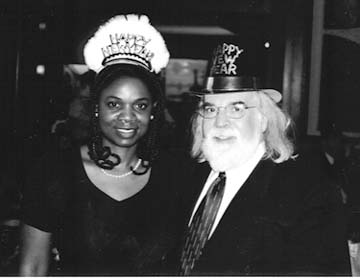 He got a lot of joy and satisfaction in
sponsoring concerts and bringing great musicians to Lincoln. Some of my
favorite music experiences were the jam sessions in Butch’s basement
with musicians like pianist George Cables and Butch’s great friend the
late drummer Norman Hedman. We took in great jazz in Kansas City’s steak
houses, The Blue Room, Jardine’s and countless other venues. I will
never forget a riveting performance by the vocalist Carmen Lundy and her
band in a New York City steak house. That was the typical music
experience with Butch. He got a lot of joy and satisfaction in
sponsoring concerts and bringing great musicians to Lincoln. Some of my
favorite music experiences were the jam sessions in Butch’s basement
with musicians like pianist George Cables and Butch’s great friend the
late drummer Norman Hedman. We took in great jazz in Kansas City’s steak
houses, The Blue Room, Jardine’s and countless other venues. I will
never forget a riveting performance by the vocalist Carmen Lundy and her
band in a New York City steak house. That was the typical music
experience with Butch.
I am grateful for the time I had with
Butch. He enriched my life with great friends who have been of great
help and support over the years. I want to especially say thank you to
the BMF consultants who annually traveled to Lincoln from across the
nation, communicated through countless e-mails and phone calls, and
shared their wisdom and ideas on how to move the BMF forward.
Kay Davis worked closely with Butch on a
variety of projects and day-to-day activities. She coordinated travel,
accommodations and meetings for board
 members and musicians. Wade
Wright’s extensive knowledge of records and unconditional friendship
were invaluable. Dan Demuth, a record collector himself, also shared his
extensive knowledge and quiet, but steady leadership. Russ Dantzler, a
jazz promoter and advocate in his own right, helped to shape the
direction of the foundation. Gerald Spaits, the great jazz bassist from
Kansas City, provided the perspective that only a working musician
could. His lovely wife Leslie was also a great supporter of BMF. Your
individual and collective contributions were essential to the success of
the BMF. members and musicians. Wade
Wright’s extensive knowledge of records and unconditional friendship
were invaluable. Dan Demuth, a record collector himself, also shared his
extensive knowledge and quiet, but steady leadership. Russ Dantzler, a
jazz promoter and advocate in his own right, helped to shape the
direction of the foundation. Gerald Spaits, the great jazz bassist from
Kansas City, provided the perspective that only a working musician
could. His lovely wife Leslie was also a great supporter of BMF. Your
individual and collective contributions were essential to the success of
the BMF.
Tony Rager, trustee of the BMF, has
worked tirelessly for the foundation since its inception in 1995. The
foundation has gone through a few changes over the years, but Tony has
always been a constant presence that we can count on. I want to thank
you for your friendship and for ensuring that Butch’s legacy will
continue to serve Lincoln far into the future. Thanks to Laura Oliva, Tony’s assistant, for all the support work that she does.
I want to say a special thank-you to Tom
Ineck, editor of the Berman Music Foundation newsletter. Over the years,
he has put out a great newsletter, which Butch called “the best bathroom
reading around.” That newsletter was and remains the heart of the
foundation. Tom reported on music and events that were not always
available in mainstream news outlets. His extensive knowledge of music
and the arts makes him a great reporter and educator. Because Tom shared
Butch’s love and passion for great music, he understood Butch’s vision
and wishes for the Berman Music Foundation. I want to thank him for his
loyalty, for being a great advocate and promoter for the foundation. I
look forward to working with him to ensure that the collection continues
to serve as many people as possible.
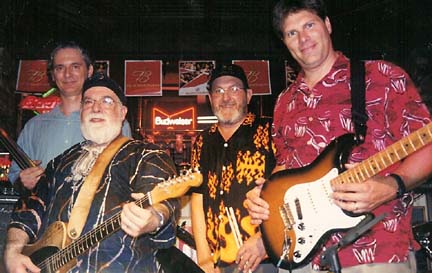 Thanks also go to the Lincoln community
for its support. One of the things that brought Butch great joy was
bringing music talent to Jazz in June. He believed in music democracy
and wanted everybody to enjoy great music without having to worry about
cost. Local musicians and the arts community were also very
supportive—Ed Love, Bill Wimmer and The Cronin Brothers are a few that
come to mind. Anne Burkholder, a great artist and our landlady for 18
years at the Burkholder Project, was always gracious. It was a great
space for our office and we hated to leave. Thank you, Anne. Thanks also go to the Lincoln community
for its support. One of the things that brought Butch great joy was
bringing music talent to Jazz in June. He believed in music democracy
and wanted everybody to enjoy great music without having to worry about
cost. Local musicians and the arts community were also very
supportive—Ed Love, Bill Wimmer and The Cronin Brothers are a few that
come to mind. Anne Burkholder, a great artist and our landlady for 18
years at the Burkholder Project, was always gracious. It was a great
space for our office and we hated to leave. Thank you, Anne.
Great people coming together to share,
promote, enjoy and make great music—that is what the Berman Music
foundation has meant to me. May the music never end.
top |
|
BMF Tribute
BMF gave purpose,
voice to Butch’s nature |
|
By Wade Wright
Consultant, Berman
Music Foundation
SAN FRANCISCO—I was there
at the start of the Berman Music Foundation in 1995 and was not overly
optimistic in those early days. Butch had two natural inclinations–-to
make music and to make trouble. These were not incompatible traits but
they did not make life with Butch easy. When the
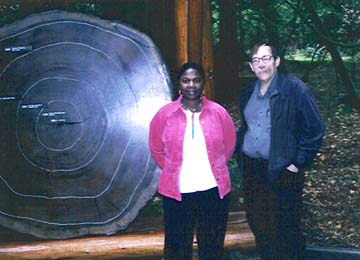 opportunity to
establish the foundation became possible, I frankly thought it would
last a year. opportunity to
establish the foundation became possible, I frankly thought it would
last a year.
But as purpose was
established for the foundation, it began to give purpose to Butch. The
musician part took over and his entire life started to make sense to
him. The enthusiasm that he felt as a player became something that he
wanted to share. The BMF gave that a voice and a world of possibility.
Not that the troublemaker
in Butch went away. I listened to his many rants because it was so hard
for Butch to understand why everyone else didn’t see it just his way.
This softened over time and I’d like to think that his determined effort
to bring music into his community was so rewarding that it overcame the
smaller parts of those moments.
Butch was diligent as a
musician. He never stopped practicing or playing, and applied this ethic
to the foundation as well. We all joked that he was the busiest
unemployed person we knew. Horizons were always expanding with ideas and
relationships, be it new records, new ideas, new friends or new songs.
The foundation became the best part of Butch.
And this is also why the
foundation must decline. Without the energy and drive that Butch brought
to it, the primary engine is gone. The pivotal collection that he
acquired over his lifetime will continue to provide inspiration. The
memories we collectively share of music and good times will remain as
well.
This is the BMF legacy
that will prevail and I believe Butch would be proud of it all. My
thanks go to my fellow consultants for great effort and concern and to
everyone that contributed to that effort. And to Butch, for his
friendship through it all.
top |
|
BMF
Tribute
BMF filled local live music void for
18 years |
|
By Dan DeMuth
Consultant, Berman Music Foundation
PUEBLO WEST, Colo.—Here are a few
thoughts on being a member of the advisory board of the Berman Music
Foundation, some bittersweet but most in a positive vein.
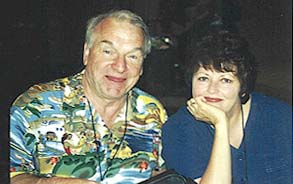 For a period of time while serving on
the BMF board, I also served as an
elected board member with the Pikes
Peak Jazz and Swing Society (PPJASS) in the Colorado Springs area. This
is a dues-paying organization of some 500-plus members with a monthly
payment to attend a jazz outing. Additional donations from members also
help PPJASS in its mission. For a period of time while serving on
the BMF board, I also served as an
elected board member with the Pikes
Peak Jazz and Swing Society (PPJASS) in the Colorado Springs area. This
is a dues-paying organization of some 500-plus members with a monthly
payment to attend a jazz outing. Additional donations from members also
help PPJASS in its mission.
Occasional outside donations to the BMF
were almost a curiosity.
A comparison of the two organizations
reveals some correlation. While the BMF focused on bringing major jazz
artists to Lincoln and, when possible, sponsoring student workshops with
those artists, the PPJASS focuses on using local professionals to
provide the entertainment while occasionally bringing in major artists
to perform. Any profit from these pay-to-see performances help augment
expenses, which include providing scholarships to local young students
wanting to further their pursuit of a jazz career. These students have
to compete in literal play-offs in front of the professionals for that
honor. Perhaps there is something in that mix that can be carried on in
Lincoln and its environs.
With Butch’s mercurial personality, I
witnessed some mutual ego-bruising and rhetorical shin-kicking in his
relationships with other players on the local music scene. That’s
probably the norm anywhere, and Butch had just enough bocce equipment to
pull it off. Regardless, the final results were certainly beneficial to
the local jazz community, both players and fans. Elsewhere on this
website, Tom Ineck notes the BMF’s sponsorship of numerous events
enriching the local scene. The reader might want to take a moment to
ponder the void that would have been without it.
And now the coda, the last gig. Turn out
the lights, the party's over. I will miss the personal contact and ideas
shared at our board meetings with Gerald and Leslie, Grace, Kay, Laura,
Rich, Russ, Tom, Tony and Wade, the discussions of what had been
accomplished and what might come to be. Others on the periphery also
helped in many ways. I’m looking forward to some type of continual
relationship with all. With deference to our founder, it’s been a gas.
Goodnight, Butch.
top |
|
BMF Tribute
Butch Berman was a
champion of music |
|
By Russ Dantzler
Consultant, Berman
Music Foundation
NEW YORK CITY, N.Y.—When
asked to write about what the Berman Music Foundation has meant to me, I
shared the same question with jazz singer Karrin Allyson.
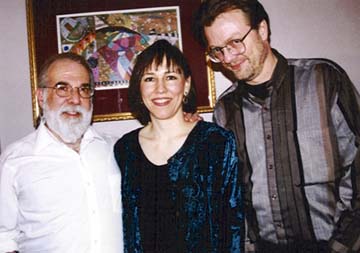 “I was very fond of Butch and his unique, enthusiastic approach to
presenting music,” she said. “I know he loved it very much, and I so
appreciate his support of me and my music from very early on. He went
far too early, but his legacy will long be remembered and loved.” “I was very fond of Butch and his unique, enthusiastic approach to
presenting music,” she said. “I know he loved it very much, and I so
appreciate his support of me and my music from very early on. He went
far too early, but his legacy will long be remembered and loved.”
Karrin helped to reinforce something I wanted to say. Musicians and
the non-commercial music that moves our hearts require our support.
Whenever you buy a CD, pay a cover, or buy a meal or drink in a club
with live music, you are part of the survival of those performing
artists. Butch Berman did even more. Butch helped to raise Karrin,
Norman Hedman, Kendra Shank, Bobby Watson and other great musicians a
notch in their careers, as Karrin attests. He created gigs that exposed
new audiences, supported recordings that never would have happened,
backed up his heart with his wallet, and shared that with all of us.
Leaving too soon indeed, Butch left us, his consultants, with the
responsibility of helping musicians all that we could. A crashing stock
market shortened a mission we all wished could have gone on for decades.
Consultants had the difficult task of placing the collection in good
hands.
At first, we wished it could have gone to KZUM, Lincoln’s community
radio station, but we wanted it to be safe and accessible for all,
especially for the best radio station, by far, in Nebraska for the long
run, no matter what might happen to broadcast media. UNL’s School of
Music Library seemed the best guarantee of safety and accessibility for
music students in perpetuity. The collection will help music students
have access to musicians they would otherwise not be exposed to. Butch
will continue to spin things for people that he knows will surprise and
delight them.
I am truly grateful for having had the opportunity to help Butch
help our heroes. May the music that the Berman Music Foundation
supported never end.
top |
|
BMF Tribute
Chance encounter led to musical
connections |
|
By Gerald and Leslie
Spaits
Consultants, Berman Music
Foundation
KANSAS CITY, Mo.—You never
know how an encounter with someone you meet will influence you.
 While performing at the Topeka Jazz Festival one year, during
a dinner buffet, I found myself standing next to Butch Berman. I had
seen him around and heard he had a music foundation. He was, indeed, an
original. We struck up a
conversation, discovered we had much in common, and became good friends.
It was like that with Butch. He met people and formed instant lifelong
connections and remained a loyal friend. While performing at the Topeka Jazz Festival one year, during
a dinner buffet, I found myself standing next to Butch Berman. I had
seen him around and heard he had a music foundation. He was, indeed, an
original. We struck up a
conversation, discovered we had much in common, and became good friends.
It was like that with Butch. He met people and formed instant lifelong
connections and remained a loyal friend.
Butch sought out music and musicians he liked and worked to help
and support them. He was instrumental in helping me put out two CDs by
the late Russ Long, our good friend and, in my opinion, a Kansas City
jazz legend. We shared one of the most memorable events together when we
performed a concert of Russ' music at Jardine’s shortly before Russ
passed away. The entire KC jazz community packed the place. It was an
emotional evening for everyone. Butch's support in helping bring the
music of Russ Long to CD and being able to perform his arrangements
meant so much to Russ during his final months.
There were other projects Butch and the foundation helped with—The
Westport Art Ensemble CD and release party and booking many Kansas City
jazz acts in Lincoln and elsewhere.
We were pleased when Butch asked my wife Leslie and me to be on the
Berman Music Foundation board of directors, which we have both enjoyed being on and working
with everyone on it. We've met a lot of new friends through Butch and
the foundation and are both grateful for that.
It is sad to see the newsletter go. I know Butch put a lot of time
and hard work in every issue and Tom has done a great job with it. We
are glad to see the bulk of his collection go to the University of
Nebraska-Lincoln, where it will be preserved and will have an influence
on future musicians.
top |
|
BMF Tribute
BMF history inextricably linked to its
founder |
|
By Tom Ineck
Consultant, Berman Music Foundation
LINCOLN, Neb.—The history of the
Berman Music Foundation is inextricably linked to the spirit of its
founder and guiding light. Butch Berman was a force to be reckoned
with—as a musician, as a record collector, as an irrepressible raconteur
on many subjects, as a hedonist with a huge appetite for life, and as a
devoted patron of the arts. For Butch, if it was worth doing, it was
worth doing well and with every particle of his being.
 Inevitably,
his death on Jan. 31, 2008, had a huge impact on the future of the BMF.
The foundation had forever lost the eccentric genius that gave it a
singular purpose and direction. Those of us who remained to pick up the
pieces—trustee Tony Rager, Grace Sankey-Berman and the rest of the BMF
consultants, friends and fans—have done the best we could to carry on in
Butch’s spirit in the five years since his passing. Admittedly, it
hasn’t been as interesting or as much fun as when our leader still
walked the planet. Inevitably,
his death on Jan. 31, 2008, had a huge impact on the future of the BMF.
The foundation had forever lost the eccentric genius that gave it a
singular purpose and direction. Those of us who remained to pick up the
pieces—trustee Tony Rager, Grace Sankey-Berman and the rest of the BMF
consultants, friends and fans—have done the best we could to carry on in
Butch’s spirit in the five years since his passing. Admittedly, it
hasn’t been as interesting or as much fun as when our leader still
walked the planet.
Since 2008, tens of thousands of dollars
were given in grants to projects deemed worthy of foundation support,
from the Jazz in June concert series to a collaborative project with the
UNL School of Music and NET Television to produce the concert video
“Jazz Cabaret,” featuring UNL jazz faculty and filmed at the NET studio.
Other grants went to the Nebraska Jazz Orchestra, the Capitol Jazz
Society and Lincoln’s Symphony Orchestra. The last resulted in a
wonderful live recording with the Joe Locke Quartet, released in 2012.
Now that the BMF collection has been
donated to the UNL School of Music library and the doors of the
foundation offices have closed after 18 years at The Burkholder Project,
our attention turns to the hope that Butch’s spirit will live on in the
educational potential of the collection’s new institutional home. At
some point a little farther down the road, perhaps we can update you on
that new setting and the ways in which the collection is being utilized
by music teachers and students.
In retrospect, I can truly say that my
“work” with the Berman Music Foundation since I began writing for Butch
in early 1996 has been the best job I’ve ever had. Or, as Butch would
say, it’s been a gasser!
top |
|
BMF Memorial
Kay Davis was instrumental in BMF success |
|
By Tom
Ineck
The story
of the Berman Music Foundation is largely the story of Kay Davis
and her devotion to Butch’s legacy and the BMF’s mission to preserve and
promote unique forms of American music.
![Kay Davis, Grace Sankey-Berman, Tom Ineck, Mary Jane Gruba and Tony Rager in New York City for Norman Hedman benefit in spring 2008. [Photo by Russ Dantzler]](media/313KayDavisNYC2008.jpg) For
many years the administrative assistant to Tony Rager—the foundation’s
“legal eagle” and eventual trustee after Butch’s death in January
2008—Kay helped to shepherd the multifaceted business of running a
charitable and education foundation. But she also invested personally in
the quality and success of its programs and publications. BMF board
members and friends can relate many stories of her kindness, good humor
and attention to detail in faithfully carrying out her duties for the
foundation. For
many years the administrative assistant to Tony Rager—the foundation’s
“legal eagle” and eventual trustee after Butch’s death in January
2008—Kay helped to shepherd the multifaceted business of running a
charitable and education foundation. But she also invested personally in
the quality and success of its programs and publications. BMF board
members and friends can relate many stories of her kindness, good humor
and attention to detail in faithfully carrying out her duties for the
foundation.
Kay Davis,
69, died Feb. 23, at her son Jason’s home in Fayetteville, Ark. She had
moved to Arkansas in 2008, retiring from the Cline Williams law firm to
spend more time with her family, especially her young granddaughter,
Nina.
Lorraine Kay (Swick) Davis was born
Dec. 15, 1943, in Aurora, Neb. A
1962 graduate of Nebraska City High School, she later moved to Lincoln,
where she was active in many organizations, including the Downtown
Lincoln Association, the Downtown Neighborhood Association, American
Businesswomen’s Association, and the Preservation Association of
Lincoln. A champion of downtown Lincoln, she frequently patronized the
city’s eateries, coffeehouses and live music venues, especially the
world-renowned Zoo Bar.
Kay’s work with the Berman Music
Foundation was especially near and dear to her. She was committed to the
BMF’s presentation and promotion of live music wherever it could be
staged. As Grace Sankey-Berman notes in her story above, Kay coordinated
travel, accommodations and meetings for board members and musicians.
She drew up an impressive
chronological list of BMF grant programs and other sponsorships that is
posted on the Mission page of this website. As a proofreader for
the foundation’s newsletter and online updates, she was a stickler for
detail, often finding errors in spelling, grammar and syntax that this
writer had overlooked. In deliberations with trustee Tony Rager and the
foundation’s board members over the last couple of years, she worked
diligently to find ways to keep the BMF going.
The death of Butch Berman, preceded by the illness and
death of her son John Anthony Davis in
Seattle, was a double blow to Kay and precipitated her retirement and
her move to Arkansas. She was a
sensitive woman who knew the importance of family and of living life to
its fullest. She will be joyfully remembered and sorely missed by all at
the Berman Music Foundation.
Kay’s survivors include sons Jason and
his wife Donna of Fayetteville, and Michael Davis and his wife Lynn Ann
Kister of Seattle, Wash., and daughter-in-law Kelly Walker of Seattle.
A celebration of life for Kay will be
held in Fayetteville and Lincoln at dates yet to be announced.
Contributions to install a memorial bench in Kay’s honor in Lincoln can
be sent to Donna Davis, 12055 W. Double Springs Road, Fayetteville, AR
72704.
top |
|
University of
Nebraska-Lincoln news release
BMF donates collection to UNL's Music Library |
|
Released Monday, Jan. 14, 2013
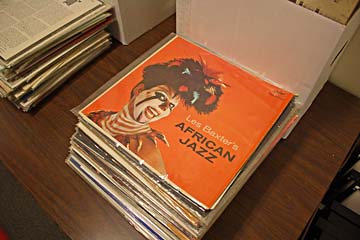
University of Nebraska-Lincoln Libraries announced today the donation by
the Berman Music Foundation of thousands of CDs, LPs, and DVDs of
jazz and rock music to UNL's Music Library. The collection's primary
focus is jazz, with additions of rock music, recordings of Butch
Berman's KZUM radio show, and videos of live performances from Lincoln
venues. Many materials in the collection are out of print and can't be
found on the open market.
 "The University of Nebraska-Lincoln's Music Library is honored to
receive this special collection, which will be maintained, preserved,
and expanded upon," said Anita Breckbill, music librarian and university
libraries professor. "The University of Nebraska-Lincoln's Music Library is honored to
receive this special collection, which will be maintained, preserved,
and expanded upon," said Anita Breckbill, music librarian and university
libraries professor.
According to Breckbill, the donation was made at the most opportune
time. The School of Music added two new advanced degrees in jazz studies—master
of music and doctor of musical arts—and
the collection will provide vital scholarship to the students working on
these degrees.
Nancy Busch, dean of libraries, says that UNL students' success depends
on UNL alumni and Nebraska community members' support of library
collection growth with either donations of collections or money to
purchase new materials.
"We are grateful for the Berman Foundation's generosity with the
donation of this collection, especially in light of the new jazz studies
program. The only way we can ensure the students' success is if we have
collections such as the Berman collection for their study and research."
 Scott Anderson, professor in the School of Music, said he sees the
donation as a wonderful asset for the Music Library and believes it has
even greater impact for UNL students. Anderson explained that the
freshman class of 2012 was born in 1994, and most students, if not all,
may have never heard the music, or musical groups found in the Berman
collection. Scott Anderson, professor in the School of Music, said he sees the
donation as a wonderful asset for the Music Library and believes it has
even greater impact for UNL students. Anderson explained that the
freshman class of 2012 was born in 1994, and most students, if not all,
may have never heard the music, or musical groups found in the Berman
collection.
"I can't wait for my students to discover and experience some of the
live performances on DVD," he said.
Anderson also said he is thinking about developing an honors course
focused on the vibrant rock scene from the 1970s and 1980s Lincoln,
which is reflected in the live performance recordings.
The rich collection was fostered by Byron L. "Butch" Berman (1949-2008)
over his lifetime and became part of the Berman Music Foundation, which
he established in 1995. The mission of the foundation, according to its
website, is "to protect and promote unique forms of American music."
Anthony M. Rager, a trustee with the foundation, said entrusting UNL's
Music Library with this special collection will fulfill the foundation's
mission. Rager said he is excited that the next generation of students
will be learning from the collection and discovering music new to them.
He personally knew Berman and described him as passionate about all
aspects of music.
"I hope the student musicians discover pieces in the collection that
inspire their imaginations and influence them to create something new,"
Rager said.
The Berman collection was moved from the Burkholder Project in the
Haymarket area to the UNL Music Library, located in Room 30 at Westbrook
Hall on UNL's City Campus. Items in the collection will be available for
check out and KZUM, Lincoln's community radio station, has been given
permission to use the collection for on-air play.
UNL's Music Library is one of the busiest in the system—second
to Love Library in traffic and check-out numbers. For more information,
visit http://libraries.unl.edu.
top |
|
Omaha
World-Herald editorial
BMF donation jazzes up Lincoln and UNL |
|
Published Saturday, Jan.
19, 2013
The jazz program at the
School of Music at the University of Nebraska-Lincoln received quite a
gift when the jazz collection of Byron L. “Butch” Berman was added to
its music library recently—and so did the city of Lincoln.
Berman, a Lincoln jazz and
rock musician who died in 2008, had a tremendous compilation of CDs, LPs
and DVDs of jazz and rock, which has
 been handled by the
Berman Music
Foundation. It offers “a history of the rock 'n' roll music scene that
happened in Lincoln,” said professor Scott Anderson. “I didn't know
there was that much of a history ... within this city, but there is.” been handled by the
Berman Music
Foundation. It offers “a history of the rock 'n' roll music scene that
happened in Lincoln,” said professor Scott Anderson. “I didn't know
there was that much of a history ... within this city, but there is.”
Reflecting Berman's
interest, the foundation emphasizes education. His “gem of a collection,
... one of a kind,” according to foundation spokesman Tom Ineck,
parallels his “eclectic and idiosyncratic” musical taste and includes
other musical styles such as R&B and big band recordings.
The collection is
particularly important to the music school because of its growing jazz
emphasis and the recent addition of two advanced degrees in jazz
studies. The school is becoming known for its jazz program: Karl Lyden
of Omaha, a senior music performance major, was named the Undergraduate
College Winner for Original Composition Orchestrated Work. He won the
prestigious award for his composition “Downside Up” at the Downbeat
Magazine Student Awards last spring.
UNL also notes that the
music school's Jazz Ensemble I, directed by associate professor Paul
Haar, won Undergraduate College Outstanding Performance honors in the
large jazz ensemble category at the awards ceremony.
The Berman collection is a
wonderful resource for students and a fine addition to the city of
Lincoln's history. The Berman foundation deserves the thanks of jazz
lovers everywhere for its contribution.
top |
|
|
|
Editor’s Note:
There is an archive of BMF newsletters at this
website in PDF format. Just click here: Newsletter
|
|